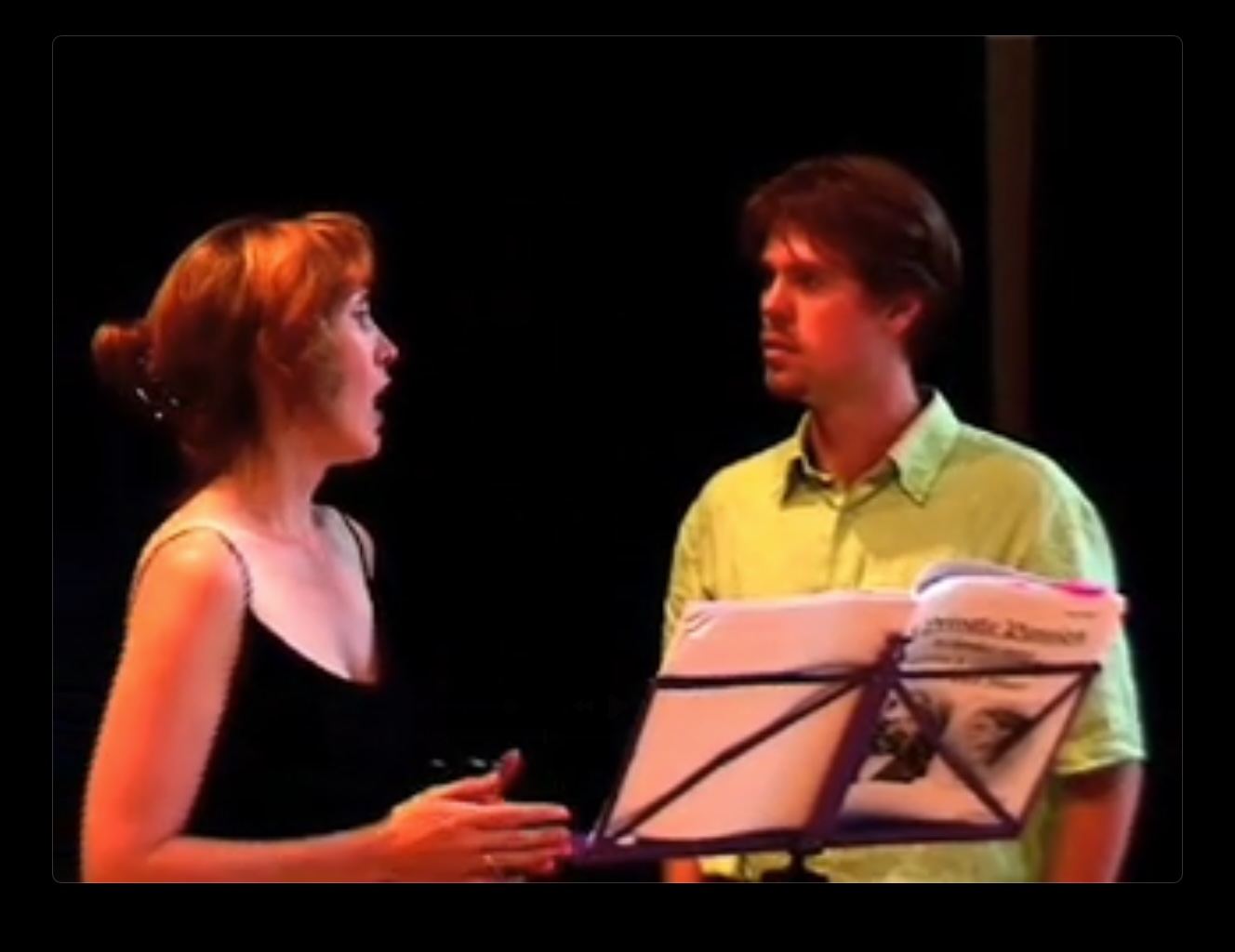
This is a two act work with many exciting possibilities – conceived on a large emotional scale, yet small enough to be performed with a touring sized company of 16-20. It is equally flexible in both stage setting and orchestration.
A Private Passion traces the 12-year relationship between Charles Dickens as a mature, nationally-famous figure and the young unknown actress Ellen Ternan. In Act 1 it explores their meeting and the conflict between Dickens’ public persona and developing his developing love for Ellen, ending with the break-up of Dickens’ own marriage. Interwoven within this we learn of Dickens’ love for the memory of his wife’s dead sister, Mary.
Act 2 takes place 10 years later and charts Ellen’s growing frustration with being a virtual prisoner. Dickens’ obsessive secrecy is threatened when they and Ellen’s mother are involved in a train crash. In the third scene, Dickens asks Ellen to put on Mary’s dress, and when she does he loses track of reality. At this point she realises she has to break away from him, and in the final scene she says goodbye as Dickens is about to go onstage for his final public reading before leaving for an American tour.
Introduction
A Private Passion is about much more than Dickens’ relationships with his wife, Catherine (née Hogarth), and his supposed lover Ellen. In endeavouring to decode the nature of his relationship with both of them, it explores the very nature of relationships between men and women, and the expectations that each have of the other. In Dickens’ case this appears to include very strong affections for sister-figures: both his own sister Fanny, who was effectively Charles’ primary carer in his formative adolescence while the family all but disintegrated under financial pressure, and the fact of his apparently-deeper attachment to two of Catherine’s sisters than to his own wife.
Mary Hogarth was only 17 when she came more-or-less to live with the newly-wed Dickens. Her sudden death within a year was a tremendous blow for the whole family. Dickens was beside himself with grief and kept the dress in which she died. Mary appeared in his dreams for years afterwards, and it is generally agreed that she is the model for many of his heroines at this time.
Georgina Hogarth was only 15 when she entered the Dickens’ household, partly to care for their children while Catherine joined Charles on his first American tour. She remained there for the rest of her life as house-keeper and nanny to the Dickens’ children’s. At the traumatic separation between Charles & Catherine she chose to remain with Dickens, and even submitted to a gynæcological examination to quell the widespread rumours that she was Charles’ mistress.
Neither of these virginal women feature directly in this story, yet their shadow is strongly felt in it. For dramatic simplicity I have conflated some of the episodes that involved them individually. I believe that Dickens’ evidently more enduring affection for his sisters-in-law than for his wife gives a clue to his feelings for Ellen. Like any other dramatist, I have simply sought to make sense of all the emotional fact(or)s in the most congruent way that is credible.
I was attracted to the subject as a result of seeing an excellent documentary about Charles Dickens’ relationship with Ellen Ternan on BBCTV by Peter Ackroyd, author of the definitive 1990 biography Dickens. The truth about what the relationship was, or how long it went on, will probably never be known because Dickens was a master at covering his tracks; but what struck me was the fact that the last house which Dickens rented for Ellen and her mother was in Linden Grove, Peckham. I lived in Peckham with my family for 14 years, and I had driven past the house in question many times. It was of the same age as our own house, and I was engaged by the symmetry of the fact for a considerable period of this time I had been engaged in a clandestine relationship outside my marriage. I felt therefore that I knew enough about the feelings of all parties in such a situation to tell the story truthfully.
Dramatically, I have taken an overtly filmic approach to the narrative, in first depicting Dickens as we think of him today, in the public image so successfully nurtured; and then slowly to peel back the myth to expose the all-too-human being and those of the two women who loved, and suffered from loving, him. The dramatic shape of Act One will lead to a strong audience ‘investment’ in Dickens’ wife, which is then shattered by the events at the end of the act. Emotionally it takes a considerable risk, which only public reception will validate … or condemn. But I felt that this would be very true to the way in which divorce does indeed shatter many more relationships than that of the agonists alone. It is also true to the brutal way in which Dickens shut Catherine out of his life, not even permitting her to attend their dauter’s wedding. Catherine seems to have lived the rest of her life with great dignity, and even to have continue to cherish the hope that Charles’ attitude would one day return to their early love. But she never featured in his life again.
Not only does Catherine never reappear in A Private Passion, but the new heroine, Dickens’ lover Ellen who has only been in two scene, takes over the whole of Act Two. Yet even so there is no happy ending. I hope that it will bond the audience viscerally to the twists of the emotional roller-coaster and will feel that this is a truthful journey, so that the downbeat ending doesn’t leave them feeling unfulfilled.
So this piece is dedicated to those who have known the agony as well as the ecstasy of asymmetric love. Problematic relationships are the staple fare of opera yet, such is our desire for platonic order, they generally achieve some kind of sexual resolution … or death. But in real life many stories don’t actually ever have endings. I don’t think Charles & Ellen did. Altho she evidently detached herself a couple of years before his death, Ellen was still summoned to his death bed by Georgina Hogarth & his eldest dauter Mamie, keepers of the vestal flame.
if I’ve captured the story accurately, its emotional core is radioactive. All of us at one time or another have experienced the attraction of a proscribed relationship, even if we haven’t done anything about it. Psychologically, this takes us onto the most fascinating territory of all – the borderland between the consciously-constructed public self-image we wish to project and our true unconscious private self. In this half-lit duende lie the ultimate truths that few of us ever reach.
Nearly all the scenes are based recorded events, but the dialog and dramatic accentuation are my own. I had hoped to use more of Dickens’ own words, but found that his ebullient verbal style, so effective in speech, lacked the simplicity which vocal lines demand if they are to engage listeners directly.
Significant Dates
1812 – Charles Dickens born
1815 – Catherine Hogarth (m Dickens) born
1836 – CD & GH marry
1837 – Death of Mary Hogarth (aged 17)
1842 – C&CD tour USA. Georgina Hogarth joins their household
1849 – Ellen Ternan born (same age as CD’s 2nd d Katie)
1857 – CD meets ET
1858 – Dickens separates from his wife
1865 – Stapleford train crash
1869 – 2nd US tour
1870 – CD dies
1914 – ET dies. She subsequently married Rev George W Robinson and bore two children.
Further Reflections
To his contemporaries, even to his wife Catherine, Dickens was an enigma. To an age of self-made men seeking to legitimise their wealth with the veneer of respectability, Dickens was the principal mythologer, and indeed it is his myth whose image we still take as the truth of Victorian society today. Yet Dickens’ power as a story-teller lay precisely in the fact that he too had a guilty secret – his family had slid inexorably down the social scale from the respectable lower-middle class to poverty and the ultimate social stigma of bankruptcy and imprisonment in The Clink, or Marshalsea debtors’ prison. Dickens himself was sent out to work in a shoe-polish factory at the age of 10 to bring in money for the family. Tho he sent his son to Eton, Dickens himself received no further education, and his later success really owes nothing to anyone but his own will to survive, and raise himself inch by inch from the gutter.
Peter Ackroyd constantly remarks on the power of Dickens’ will. Nobody seems to have been able to oppose him for long. As I show in the first scene, he did indeed refuse to be presented to Q Victoria; while his reasons were perfectly legitimate, few commoners would then –or perhaps now- have dared faced down the monarch’s aristocratic entourage. When he fell out with his first publisher, tho he was wholly in the wrong, Dickens brought them to their knees by simply refusing to honour his contract. Similarly, when he decided to end his marriage and, against all advice, published a self-serving exculpation in his journal Dickens subsequently cut any and all of his mutual friends who dared to remonstrate with him.
It may come as no surprise that Dickens should have proved himself a powerful hypnotist, successfully curing the wife of a banker in Florence who was suffering from severe depression. Whatever the secret of his phenomenal energy, in the midst of his perpetual motion Dickens could still retreat into himself and churn out the stories that defined his age like any other hack. Perhaps it was because however rich and influential Dickens became, in his heart he never for one moment forgot the starving and helpless boy in the boot-blacking factory at the foot of Hungerford Bridge? Where most people bury painful childhood memories, for him it was the nuclear fuel cell or touchstone of all his truth-telling ?
Celibacy
One person seems to have understood him – the young actress Ellen Ternan, with whom he had a relationship for 12 years. She never spoke about the nature of that relationship, and Dickens’ letters to her were destroyed by her son when he discovered them after her death. Had it not been for a fortuitous railway accident in which they were both involved in 1865 the later stages of their relationship would have remained almost invisible to history. Throuout the time of their association Ellen and her mother had lived in houses owned or rented by Dickens either in his own name or, more often, under a pseudonym. He seems also to have bought a house for Ellen, whose rent provided her with a ‘modest competence’ for life. Eventually however, mother and dauter are to be found living in an apartment in the Vauxhall Bridge Rd which seems to have no connection with Dickens.
So what was their relationship? They were certainly lovers in the sense of being connected with and belonging to each other. But was it genital? This is a fascinating conundrum. From the perspective of the 20thC most people would assume so as a matter of course: but I think it equally credible that it wasn’t. To me there is a great deal about CD’s personality to suggest that he may have been an instinctive celibate, or at least someone capable of exceptional sexual self-control. His friends Wilkie Collins and the painter Danel Maclise were no strangers to the underworld of the phallocratic Victorian economy, but all the evidence is that tho CD observed this demi-monde he never participated. Indeed the idea of Urania Cottage, the refuge for street women he founded and supervised in west London with the support of the philanthropist Baroness Burdett-Coutts, shows that he took a very constructive approach to position of women who had lost their self-respect. There was another ‘fallen woman’ whom he assisted at the request of her brother, even buying her a ticket to Canada and, unusually for him, continuing his assistance when this emigration failed: yet he never sought even to see her.
If you observe Dickens’ novels it is generally true that the deepest relationships are those of brother and sister, eg Nicholas and Kate Nickleby; and this would plainly be constructed on his own relationship with his elder sister Fanny on whom he depended during his years of emerging consciousness far more than his flighty Mrs Nickleby-like mother. I consider it entirely credible that underlying CD’s disenchantment with his wife Catherine lay the fact that the cycle of sexual engagement, pregnancy, and prolonged post-natal created a vicious cycle which Dickens may have been determined to avoid in a new relationship. Altho fore-shortened timescale of this opera presents Dickens treatment of Catherine in a pretty poor light, it should be borne in mind that for two decades he strenuously made the best medical help of his age available to Catherine.
Dickens own children certainly believed, post hoc, that their father’s relationship was sexual. In later life his second daughter Katie reminisced that there had been a “resultant son (who died in infancy)”; but it has to be said that she was something of a fantasist whose own ‘reputation’ as the wife of Wilkie Collins’ sick brother had not unimpeachable. In his 1999 biography Dickens Peter Ackroyd quotes Jane Wheeler, who was Ellen Ternan’s maid from 1866, as saying she “…never was the mistress of Charles Dickens.” And Ackroyd goes on:
We do know however, that both Mamie [his eldest child] and Georgina Hogarth [Catherine’s sister who remained as nurse-governess-housekeeper in Dickens’ household despite Catherine’s summary ejection] maintained a close and steady friendship with Ellen Ternan after Dickens’ own death. Would they have done so if she had indeed been the partner in an adulterous liaison with the man they both venerated? It is as unlikely as the possibility that Mrs Ternan would have accepted – and indeed, on the evidence, supervised – a relationship which would have turned her daughter, in the eyes of the midVictorian world, into little more than a harlot.
I myself find this, and the other evidence Ackroyd presents, credible and compelling. But I think there is valid circumstantial evidence as well. Two of Dickens’ most noteworthy successors, Tolstoy and Shaw, both famously believed that celibacy was integral to their creative powers – tho Shaw was more consistent in his practice that Tolstoy! In the 21stC we have considerable knowledge of occult sexual practices from the Eastern traditions, and the very fact that these traditions exist is testament not to their exclusivity, but to their archetypal existence in human experience. To me, everything about Dickens points to someone who had become aware of the relationship between semen-retention and life-energy.
That Dickens was a highly-charged individual is a matter of record. This might lead an ignorant person to assume that his prefered method of dis-charge was sexual – but look at his work-rate! All those novels, one after each other, as well as his editorships, and his helter-skedule of fund-raising dinners, public readings and political involvement; not to mention his practice of walking wherever he could, generally 4-7 miles a day. These Victorians put our ideas of labour-saving to shame! To me, such a pace is just not consistent with someone inclined to sexual self-indulgence: indeed you could argue that this is exactly the sort of mask someone would make who may fundamentally have been afraid, if not of sex itself, at least of its consequences – namely admitting a woman to his psyche as a full equal partner.
Who are the ghostly characters in Sc2.3? For most people, but especially men, there exists within them an image of their sexual ‘other’ formed from variety of sources, which they project onto someone whom they see as a potential partner. It is, I would argue, in the projection that physical desire arises. The characters “beckon incandecently from the borders of desire and imagination.” They represent Dickens’ ‘anima figure’, his own internal, idealized of femininity which differs from the reality and needs of his real partner as pornographic or commercialised images of (hetero-)sex do from the genuine autonomous sexual responses of any living woman. The choice a man faces is whether to make the arduous journey to understand and respect the sexuality of a woman/women or to continue to imprison them within their own projection formed by the repressive semitic philosophy we have inherited. It’s my personal belief that Dickens was unable to make that journey. The nearest he got to it was with Catherine, and that when her increasing neediness threatened the ivory tower of his imagination he did away with her as ruthlessly as any Bluebeard. Her replacement, Ellen, was to have none of Catherine’s inconvenient characteristics.
Therefore the reading of Dickens’ psychology which I have encapsulated in this scene starts from my belief that at some point Ellen would also have been likely to assert her female impulse to ‘real-ise’ their love by conceiving a child. (Perhaps one did exist? Perhaps it didn’t?) And that that would have been as insupportable to Dickens as her barrenness was to Ellen. In such a situation, a minor stroke might have felt or seemed to Dickens exactly the same as a retreat from the unanswerable demands of the objective world into his powerful subjective inner world, where he alone defined and controlled ‘reality’.
And for better or worse, the potency of that mythic reality lives on today …
A Private Passion was started just after I had facilitated the Spirit Zone of the Big Green Gathering on 7/8/02 (a greater contrast to the world of Dickens and opera could hardly be imagined) and concluded on 7/7/03 while preparations were well advanced for the 2003 BGG.
Tisbury, July 2003
Synopsis
Act One (64′)
1.1) 4’30” Royal Command Performance.
CD & his children come offstage having just appeared before Queen Victoria in an amateur melodrama ( The Frozen Deep written by CD & Wilkie Collins). A minor scandal is caused when he refuses to allow his dauters to be presented to the Queen because it would injure their reputations to greet her as actresses. A promoter proposes a professional tour of the play. Afterwards, CD leaves the children to his wife Catherine’s care, and goes out to dine with WC.
1.2) 8’30” Nightwalk.
Later that evening, CD & WC emerge from a restaurant. In response to WC’s request for literary advice, CD leads him to the slums to learn compassion for how the urban poor survive. Meeting a Homeless Mother & Child, they find them lodgings. As dawn rises WC slinks off to bed but CD is still going strong.
1.3) 8’15” In the Office of Household Words,
the magazine CD edits, he is writing, still in evening dress, when his clerk Wills arrives late. Without ever interrupting his writing CD ticks Wills off, and then conducts a business conversation with his manager John Forster. Reaching the end of a chapter, CD stops and reads it to them …
1.3a) Christmas Carol .
As CD reads, the Characters all appear and sing their eponymous parts. At the end, the scene dissolves back to the office with Wills & Forster open-mouthed in admiration.
1.4) 11’ The Dress. Night.
CD enters his bedroom with an oil lamp. Moving furtively as if afraid of waking Catherine, he goes to a cupboard and takes out a young woman’s dress, holding by the shoulders as if it contained a real person. As he sings of his grief at ‘Mary’s’ death, he buries his face in it like a sacred relic – but the nature of its owner or her relationship to CD remains a mystery.
1.5) 2’45” Prize giving.
In the presence of his wife and various civic dignitaries CD makes the closing speech of a ceremony in the newly-opened Birmingham Mechanics’ Institute.
1.6) 8’30” Play Rehearsal.
The professional cast of The Frozen Deep reaches the end of its first morning’s rehearsal. He has laid on a huge spread for lunch, and as it is brought one of the actresses, Maria Ternan tells her colleag-sister Fanny of her intention of seducing CD, while on the other side of the room WC gives CD a worldly appraisal of them. But during the scene we realise that at the principal attraction exists between CD and the youngest Ternan, Ellen, who is of the same age as CD’s own elder dauters.
1.7) 5’30” Mrs Dickens returns from visiting Mrs Ternan.
CD is writing in his study when Catherine enters, furious at having humiliated herself by paying a social visit on Mrs Ternan at hia request. She exits threatening to leave home. Their dauter Mamie, who is a year older than Ellen, is passing the door and enters to commiserate with her father.
1.8) 7’45” Dinner at the Ternans.
CD is at dinner with Ellen & Mrs Ternan. When the latter has to leave, he opens his heart to Ellen. She responds reticently, but eventually they sing a love duet in the knowledge that an irrevocable transaction has occurred.
1.9) 7’30” The end of Dickens’ marriage.
CD enters his dressing room late at night after making a political speech. Catherine, offstage in the bedroom, wakes. At first they exchange pleasantries, but soon the simmering disagreements between them flare up, and Dickens furiously rings for the servants, from whom he demands wood, hammer and nails. When these are brought he begins to nail them across the adjoining door to Catherine’s room. The noise wakes their son who comes in crying. Ashamed of himself, Dickens leaves home telling Catherine their marriage is over.
Act Two (55′)
2.1) 13’ Awaiting Charles Tringham.
In 1865, while writing Our Mutual Friend , CD rented two semi-detached cottages in Slough High St in the name of Charles Tringham. Ellen and her mother unveil themselves after returning from the shops and await CD’s arrival. She bitterly laments the shame of having to live incognito, waiting for someone she loves but hardly ever sees. When he arrives CD forestalls ET’s complaints with the promise of a French holiday. They sing sadly of the impossibility of acknowledging their relationship in public. In the end ET leaves to go to bed without the baffled CD.
2.2) 4’45” Train Crash.
CD, ET & MrsT are returning by train from their happy continental holiday when they are derailed. In the ensuing chaos the Guard is suffering from shock, and so CD takes control of the entire rescue effort – before swearing the other male passengers to secrecy and escorting the Ternans away from the scene.
2.3) 31’30” The Ghost’s Dress.
After 10 years of this clandestine relationship CD & ET still love each other, but Ellen is more dissatisfied than ever by the limitations governing their relationship. CD refuses to acknowledge the pulmonary illness brought on by his relentless pace of work, travel and physical exercise. He invites her to join him on a planned reading tour of the US, promising that they can live openly there. She tells him it’s ridiculous to expect this will ever be possible. By way of reconciliation, when he asks her to put on Mary’s dress (Sc1.4) she agrees, knowing nothing of its provenance.
While she is offstage changing into it the 6 principal heroines from CD’s novels appear to him in the room as hallucinations. When ET returns he cannot distinguish between her and the fictional characters, indeed he sees her as Mary (whom, we discover, was Catherine’s younger sister who died while living with them as newly-weds). Horrified at this misidentification Ellen tears off the dress and confronts CD with the fact that she is having a period and challenges him to give her a child. They have a furious confrontation in which Ellen is only saved from Dickens’ blows by the intervention of the ghostly heroines who then join with Ellen in an extended acappella lament of the female condition. At this CD breaks down and reveals what he has never previously told anyone, not even Catherine, that the fear behind his incessant activity (which was in fact to kill him within the year) is his childhood shame at his family’s imprisonment for debt.
Yet when it seems as if CD & ET are becoming close for the first time at this deep level, the ghostly heroines surround and seduce Dickens, coaxing him off into the bedroom while ET is left alone.
2.4) 5’15” The Final Reading.
CD & ET are in the ante-room of a large hall before he gives his final public reading in England prior to setting out for America I 1869. He is obviously unwell but driven on by immense public acclaim. Wilkie Collins arrives to wish him luck, and is surprised to see Ellen, whom he greets as a stranger. CD is called to go on, and ET & WC linger behind for a moment. He is astonished and incredulous when she tells him of their 12 year relationship, and how she has finally decided that it is hopeless. Out of loyalty to his friend WC urges her to reconsider, but Ellen replies that she has finally given up believing that Dickens will ever acknowledge their relationship; and is finally facing the fact that “I’ve been his ‘daughter’ for long enough. Time to grow up, be an independent woman.” She concludes “I once had hopes which now have fled: there’s nothing to be gained by staying: /And in the heartbreak I don’t know who’s been betrayed and who’s betraying.”
Characters
Principal
| Charles Dickens | 45…57 | high baritone | |
| Catherine Dickens | 42 | dramatic mezzo | his wife |
| Ellen Ternan | 19…31 | dramatic sop | his lover |
Minor Principals
| Edward Dickens | c12 | boy alto | Sc1.1 son, doubles Railway LookOut Sc2.2 |
| ‘Plorn’ Dickens | c8 | boy alto | 1.9 son, (could be taken by Edward) |
| Mamie Dickens | c20 | soprano | 1.1 & 1.7 dauter |
| Mrs Ternan | c45 | alto | 1.6/8 & 2.1/2 (could double Homeless Mother, 1.2) |
| Wilkie Collins | 30s | tenor | 1.1/2/6 & 2.4 protégé & fellow novelist (could double Train Guard, 2.2) |
| John Forster | c50 | bass | CD’s agent (could double Lord Hartington 1.1 & Railway Foreman 2.2) |
Semi-Chorus playing Single Scene Parts
| LookOut | boy | alto | 1.22.2 poss Dickens’ son |
| Fanny Ternan | 20s | soprano | 1.6 Ellen’s sister |
| Maria Ternan | 20s | soprano | 1.6 Ellen’s sister |
| Driscoll | mezzo | 1.9 Dickens’ servant | |
| Homeless Mother | alto | 1.2 | |
| Forsyth | tenor | 1.1 theatrical promoter | |
| Wills | 30s | tenor | 1.3 Dickens’ clerk |
| Wigthorne | 30s | tenor | 1.6 actor |
| Train Guard | tenor | 2.2 | |
| Passenger 1 | tenor | 2.2 | |
| Matthews | baritone | 1.9 Dickens’ servant | |
| Passenger 2 | baritone | 2.2 | |
| Theatre Usher | baritone | 2.4 | |
| Lord Hartington | bass | 1.1 | |
| Railway Foreman | bass | 2.2 |
Semi-Chorus also appears in the following scenes…
| 1.1 | Melodrama | audience & stage-hands (mute) |
| 1.3 | Christmas Carol Reading | Characters in the novel |
| 1.5 | Prize-giving | Dignitaries & off-stage chorus |
| 1.6 | Melodrama Rehearsal | Extras & Waiters (mute) |
| 1.9 | Marriage breakdown | Full chorus off-stage |
| 2.2 | Railway crash | 10 part off-stage semi-chorus & onstage Passengers & Railway Track-workers |
| 2.3 | Ghost-Dress | 6 part female semI-chorus inc high soprano appear as Heroines from Dickens’ novels |
| 2.4 | Final Reading | Full chorus off-stage |